
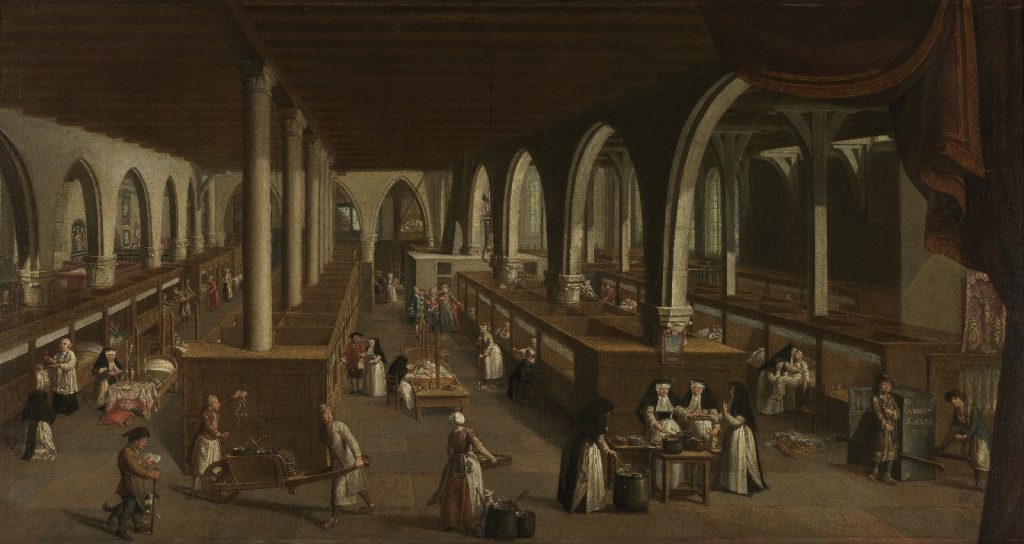
Jan Beerblock, De ziekenzalen van het Sint-Janshospitaal (The Wards at Saint John’s Hospital), 1778
March 2020, Twilight Shift
The hospital had one very big perk for a junior doctor at the time, a large doctors’ mess facility. Unlike most doctors’ messes, limited to the whole spectrum of cupboard sizes, from the cozy and modest kitchen cupboard to the ballroom-like understairs cupboard, Trentshire Hospital had a very large mess on the top floor, extending out into a large balcony that overlooked the city. The young doctor could, after feasting on near limitless toast, treat themselves to a game of snooker with a good 80% of the balls present. Through this policy of bread and games, the trust CEO was able hold off revolutionary insurrection by junior medical staff.
The atmosphere of the mess was, however, different from its usual exhausted ebullience. People were engaged in deep conversation, eyes flickering to a tired plasma screen TV displaying the rolling red ticker tape of BBC News 24. The same scenes from Italy and Spain played over and over, flashes of humanoid figures, wrapped in sterile material, pushing gurneys, setting up oxygen masks and, towards the end, collapsing in exhaustion, their body language saying everything their faces couldn’t.
I continued past onto the balcony. Spring had finally arrived after a long winter, with plenty of the staff filtering out to enjoy what might have been a very brief patch of warmth. It was getting to 6pm, and the sky had already started illuminating itself in golds and purples. Murmurings were going about concerning institutions of lockdown. Boris Johnson was due to speak, and, given the institutions of strict quarantine in Italy and Spain, where the pandemic first hit in Europe, we all prepared ourselves for the inevitable.
The sunset took greater symbolism. Unbeknownst to us, the last light of an era of comparative calm was setting, a long night to follow. Most of us would never again be the same people we were in that moment, the differences only seen once the pandemic had come to pass, where we finally allowed ourselves the moment to reflect on its long lingering human cost.
BBC News’ voice chattered in the background, an oracle with a clipped RP accent, dispassionately declaring what the future held in store for us, no room for illusion or metaphor. The country was to be locked down, pinstripe trousers and collared shirts swapped for the simple blue habit of a modern-day plague doctor, and we were to walk through silent streets into the even greater silence of a dying hospital.
April 2020, Night Shift
“You will be knee-deep in the dead.”
It was difficult to follow the remainder of the briefing following Dr Tudor’s terse and weary summary. He had completed twelve hours as the emergency medicine consultant-in-charge, and was to begin another twelve covering the hospital’s on call service from home.
I was a relatively new doctor, having qualified several months earlier in July 2019. I had spent most of the intervening time delivering babies, but they soon asked for volunteers and, following the tradition of young men’s excited bravado in international crises, immediately stepped forward. So, there I sat, utterly unprepared, looking across the tables to my senior colleagues, their faces mirroring mine.
The grim realisation was that my lack of experience didn’t matter much. The British medical profession had done well to avoid a pandemic for the better part of a century, the Spanish Influenza a matter for historians, but this had consequently rendered us at all levels practically and emotionally unequipped for death on this scale.
The Covid-19 pandemic was a leveller in how we practiced medicine. Patients would be divided into those for escalation to intensive care and those not for escalation. To be treated in intensive care required surviving a general anaesthetic, remaining in the induced coma, and being ventilated via an endotracheal tube. It was the most invasive version of the simple treatment that characterised most of our management of Covid – giving oxygen. Those who would not survive the intensity of the above treatments, those too old, too frail, suffering from too many other illnesses, for whom such invasive and unpleasant therapies would be futile, would be limited to being treated on normal wards alone.
The latter group formed the majority of the patients on the Covid wards, the intensive care units, high dependency units, operating theatres and recovery units having already been filled to capacity. The medicine was, for practical purposes, easy. After a dose of dexamethasone, theoretically to relieve the burden of inflammation on the lungs, you would apply an oxygen mask. Then you wait. Should this fail, blood oxygen saturation collapsing despite the maximal amount of oxygen, palliation would be the only remaining treatment.
If there is anything a pandemic doctor came to learn, it was how to palliate.
Palliation is much more than just giving morphine; it is the essence of what it means to be a physician. Palliation is characterised by our letting go of all our assumptions and expectations of modern medicine. Gone is our scientific positivist notion of an objective truth, that the human form can be purely rationalised, everything potentially fixable. If to be a doctor means solely to be able to cure, then we can no longer be doctors. Our hubris, to use an unkind word for ourselves, vanishes, as we must go to something deeper in the heart of the profession, its essence: Mercy.
Good palliation means understanding how to talk to the patient’s relatives on the phone when you wake them in the middle of the night, it’s knowing when to hold their hand. Good palliation is when you allow your humanity to characterise your role as a physician, where your heart shares even the smallest shred of the suffering belonging to those you serve.
Our education in mercy began on the wards once Dr Tudor dismissed us. As we began to cover several floors of wards, most of them repurposed for the pandemic, the jobs would start streaming in on the old smartphones we had instead of bleeps, nurses summoning us for help.
Review: Desaturating patient
Review: Desaturating patient
Review: Desaturating patient
Review: Desaturating patient
Review: Desaturating patient
Review: Desaturating patient
Review: Desaturating patient
The hospital at night took on a purgatorial aspect. A relatively modern hospital, two long, cavernous corridors formed the spine of the building. From one end, looking down to the other end, the corridor simply never stopped, instead vanishing into a black void. Crossing this spine like ribs were dark alcoves that formed the entrances to the many wards. Behind them, the same sad story being played out by different unwitting casts.
“Who do I review first?” I muttered to the void. The void not caring to respond, or even stare back, I instead picked the patient with the worst-looking vital signs. Over the night I worked down the list, eventually arriving at Ward 401.
Mrs McCarthy’s oxygen saturations were far from the >94% they ought to have been. They were in the low 80s, and she was breathing fast and deep, unable to get a word out. Despite the fan in the corner of the room blasting away at her, the beads of sweat on her forehead continued to gather, telling a sadder story. Clutching her hand, thin and bony with age, was her daughter, Jackie, smuggled in by a sympathetic nurse. Acknowledging my arrival, her eyes remained fixed on a monitor in the corner. The oxygen mask hissed with the maximum amount it could give – 15L per minute, Mrs McCarthy’s lips cracked and raw from the relentless treatment.
SpO2: 83%
“How are you feeling Mrs McCarthy?” ice-chip-blue eyes framed with dried tears flicked over to me. She happily nodded in the way her generation always did in that situation, nodding that everything was fine, despite dire illness, as if to say sorry for the inconvenience.
SpO2: 82%
I took her other hand. Delivering babies made me realise the importance of showing simple human warmth, disavowing me of any preconceived professional awkwardness in expressing it. The last mother’s hand I held was that of a woman in her twenties, her new baby being cleaned by the midwife, still covered in unmentionables from the caesarean section. I reassured her the baby was fine, and soon the new life was passed over to her breast, held close, warm and safe.
SpO2: 81%
Now I held the elderly mother’s cold hand, her equally teary daughter across from her holding the other. The same love, unabashed, unbroken.
SpO2: 80%
My heart twisted as I realised the object of the daughter’s gaze. She was looking at the vital signs behind me on the monitor, the oxygen saturations. Her hand holding had a dual purpose, it kept the saturation probe fixed firmly on her mother’s hand, as if to convince it of a higher reading.
Defining death can be difficult, having legal, religious, medical and philosophical implications. We read of somebody dying in the news, and see death simply as a liminal threshold: there was life, and then there wasn’t. In that moment of change you have your death.
The experience of death differs from this, though. Death is an event, death can be long, death can be seen and felt. For Jackie, death was the declining number in blue luminescent digits, the oxygen mask hissing, her mother’s cold hand.
For me, the notes I read before entering the room painted my experience. The intensive care doctor quickly reviewed all patients before they came up to the ward, noting her advanced age and numerous comorbidities, deeming her not for escalation to intensive care. Being on the maximum amount of oxygen, yet still declining, she was dying. Before I had even met her, I was experiencing her death.
The daughter’s eyes were now on me. She realised she had been found out and was almost embarrassed. Beneath the masks, gowns and goggles, there was little left of the human form to communicate with but the eyes. Hers were wide and desperate. Hope is often a beautiful thing, but in palliation, it can be a source of tremendous pain, the time even for miracles having passed.
I turned the monitor around, obscuring the numbers, and sat on the end of the bed.
“You remember what the intensive care doctor said, don’t you?”
They nodded, paused, then the daughter looked at me more intently, nodding again, realising what lay beneath my words.
“I think we should prioritise making you comfortable now, Mrs McCarthy.”
Such a cowardly phrase, I thought. I clarified further.
“We’re giving you all the treatment we can, but your oxygen levels are still going down. I think you’re dying.”
My world, Mrs McCarthy’s and Jackie’s came together. We started experiencing death in the same format. Jackie welled up, and Mrs McCarthy solemnly bowed her head in agreement. I have rarely seen an elderly person fear death.
“We can give you morphine now. It will reduce that horrible breathlessness you feel, and it will help you with the pain, but it may mean death comes faster.” She gazed searchingly at me, such a deeply complex question reduced to a simple binary.
Jackie squeezed her mother’s hand, then looked at me. They had clearly already spoken about what to do should she reach this stage. Mrs McCarthy nodded her consent, and I quietly left to ask a nurse to prepare the morphine.
Before leaving the ward, I made Jackie promise me to keep the monitor turned away, and to look upon her mother instead. We took off the brutal 15L mask and added small 2L nasal cannulae instead, just enough oxygen so that, combined with the morphine, the torture of breathlessness could be assuaged. For some time, Jackie had her mother back, and her mother had the strength to get her last words out. I never found out what they were, but I could guess at them.
Life becomes most apparent as it fades into absence, making social, psychological and spiritual care so much more important. There was no priest, nor could there be, the rules back then stating that the only cleric that could be present was a hospital chaplain, but in these situations, the roles of priest and doctor can blur. There can be no religious element to a doctor’s professional practice, and for very good reason, but the pastoral and human elements are very much present. The Anointing of the Sick follows its introductory prayer with the laying on of hands, a symbol of healing readily visible in the Gospels, but also beyond Christianity in other beliefs and cultures. To lay on hands is to heal, to protect, to share in suffering. Like the mother’s hands clasping her newborn for the first time, or the dying holding their loved one in their final moments, the laying of hands transcends mere physical closeness, conveying an emotional, even spiritual, warmth. Whether temporal or spiritual, what it always is is an act of love. The love that is at the heart of mercy.
The Viaticum that follows the anointing sees the administering of the Blessed Sacrament. The rite is unambiguous in its role not being to the sick, but to the dying. It is an act of spiritual palliation, providing cleansing comfort to those whose passing is imminently expected. The comfort we administer as physicians differs. It is physical, not spiritual, but it is offered with the same mercy and love, and with the same honesty. Most of our patients were and are not Catholics, but this highlights the elements of medicine that go beyond modern medicine, that are ageless: the simple acts of love and mercy.
An hour later another message came through on the smartphone. It was some time before I could get down to the ward, other sick patients going through what Mrs McCarthy had.
Review: Death verification.
I noted the location of the call, Ward 401.
Mrs McCarthy laid still. No more oxygen hissing, no glow from the monitor, the beads of sweat mopped from her brow. The sky had resumed its reds and purples, warming the room, as daybreak suggested its arrival, and Jackie laid slumped halfway over the bed, next to her mother, arm over her, holding on like she had as a newborn. She groggily raised her head. This time there were no tears, eyes no longer wide with the pain of hope. She unlinked her hand from her mother’s and laid it respectfully back on her chest.
“I’m so sorry Jackie.” I said. Her eyes smiled her thanks as she filtered past me.
I opened Mrs McCarthy’s eyes and checked her pupils, diligently feeling for a pulse and listening to her chest. Encountering only silence, I gently closed her eyes, and whispered one final, respectful goodbye.
I proceeded out of the ward and back into the corridor, pausing for one stolen moment of reflection, rubbing my eyes. Looking down to the other side I allowed a small smile. The void had been consumed by the rising sun, and the corridor was now bathed in light.